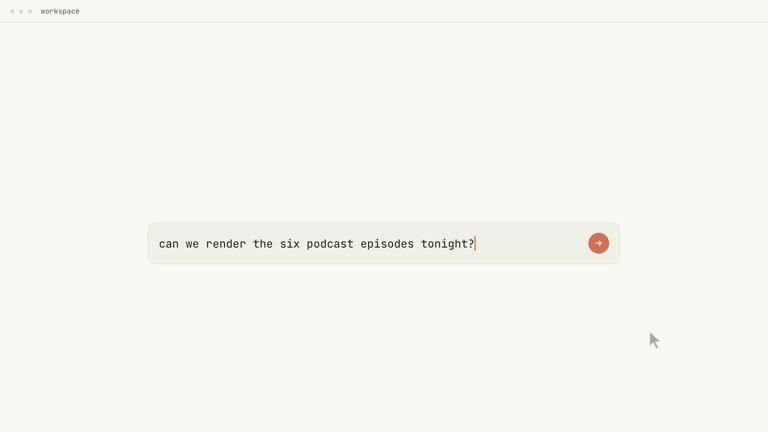
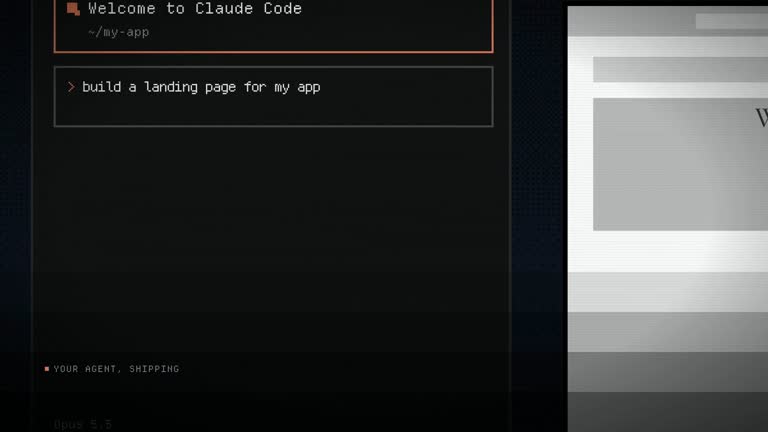
Announce a feature by answering an objection your users already know. Objection-Reversal opens with illustrative complaint cards, intensifies the problem and then turns toward the capability that now resolves it. The second half must supply product evidence: a launch claim only works here when the complaint is genuinely out of date.
What you get
A method for a forty-to-sixty-five-second, 1920×1080, 30 fps H.264/AAC launch film authored in HTML, CSS, SVG and GSAP, with your own palette, typography and copy rather than generated or stock footage.
A seven-act plan: objection cards, escalating zoom ladder, short turn, invocation, agent run, proof and thesis/lockup. The glass-card and terminal systems carry eight copy-slot types through the story.
Instructions for creating an editable HyperFrames project with storyboard, per-act scene files, cut ledger and a shared design stylesheet. The invocation and agent run share a continuous window rather than being arbitrarily separated.
A retarget checklist linking a real customer objection, the actual new capability, brand values and proof material. The archive is documentation for production; no complete project or rendered launch is already included.
Before you choose
Choose this only when the release can visibly answer the complaint. Write the objection and the proof next to each other before developing the opening. If the evidence does not resolve the same issue, a more forceful turn card will exaggerate the gap rather than repair it.
Good fit
A feature release that resolves a repeated customer objection and can now show how.
A team with real complaint context, its own brand material and a recording, capture or truthful interface demonstration for the payoff.
A launch expected to be revised later through editable copy, color and scene files.
Not for
A neutral explainer, tutorial or feature tour with no meaningful objection to reverse.
A talking-head, voiceover-led or live-action production. This format is text-driven and its large copy carries the argument.
A launch where the opening objection remains true or the new capability has no visible proof.
How to use
You say/hyperframes-objection-reversal-launch People kept saying Lumen can't read their real dashboards. We just shipped it — make the launch film.
Identify the repeated objection and the exact capability that now answers it. Gather product material, a short invocation and two type families with the palette, or the product’s own site from which to derive them.
Write the complaint representations and turn before composing scenes. Keep accounts, avatars and engagement details clearly fictional; use the genuine objection as the basis without presenting fabricated posts as actual public testimonials.
Choose proof material. A recording of the real feature is strongest; a live capture or faithful rebuild of your own interface is the documented fallback. If no truthful demonstration is possible, resolve that gap before building a dramatic reveal.
Prepare HyperFrames CLI, Node.js 22 or newer and FFmpeg and locate the referenced motion workflow. Author the storyboard, cut ledger and shared styles, then build the complaint cascade, monotonically increasing zoom ladder and continuous invocation/run scene.
Review copy at playback speed, inspect each act’s frame and check that the proof actually rebuts the opening claim. Run documented lint/check and render verification, inspecting dimensions, frame rate, duration and any audio behavior. Retain the final copy, proof source and editable project with the handoff.
Requirements and costs
You bring
The product and the specific capability being launched · The customer objection the launch answers · Brand colors and two type families, or a site the palette can be derived from · Optional screen recordings of the real feature
v1.0.0 — Claude Code / Claude Desktop / Cowork / Codex / ChatGPT
FAQ
A real recording is the strongest proof, but the guide also permits a live capture or faithful rebuild of the product’s own UI. State which was used. If there is nothing real to demonstrate at all, the film does not yet have the payoff its structure promises.
The underlying objection should be genuine, but the on-screen accounts are illustrative. The guide invents handles, avatars and engagement details and does not reproduce real accounts or screenshots. Make that representation clear rather than implying the invented cards are actual customer posts.
The documented toolchain is HyperFrames CLI, Node.js 22+ and FFmpeg, plus the motion guidance the package references. The workflow does not call image, video or avatar generation models; local rendering does not carry a per-frame generation API fee.
Narrow the opening and the proof to what the release genuinely resolves. This structure should not declare a broad complaint obsolete when important parts remain. A more qualified announcement may need a different story.
No. The package contains the guide, film blueprint, visual system and retarget checklist. The agent still authors the scenes and final MP4 for your product.
User reviews
—0 reviews
Select a star to share your experience.
No reviews yet. Ratings appear once readers share real experiences.