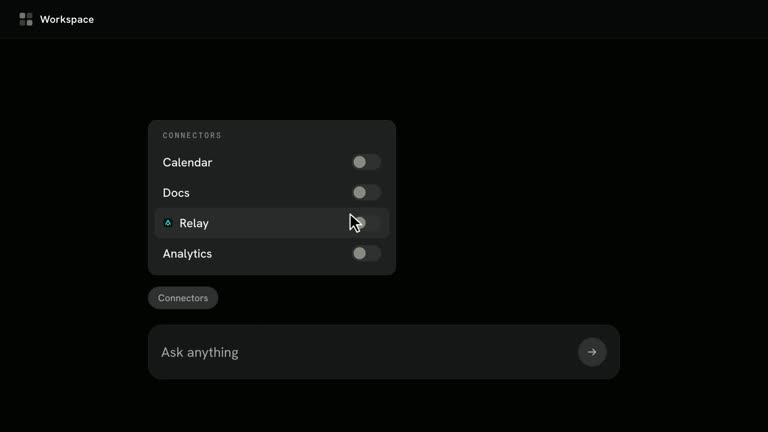
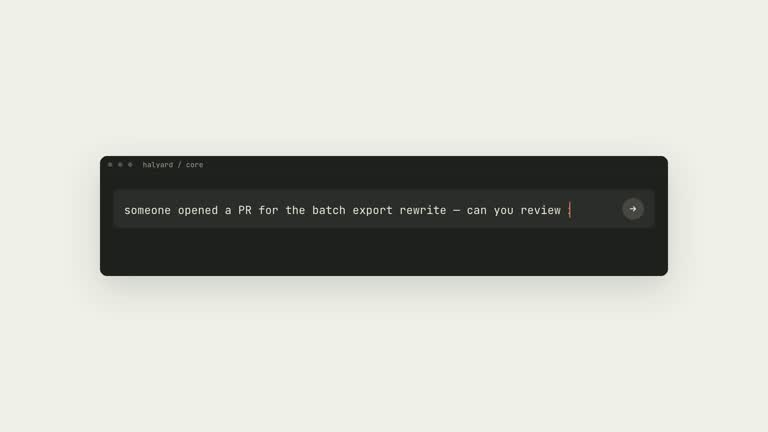
Show one useful operation and the result it produces. Linear Agent Style Launch Video uses a black stage, steep-perspective product surfaces, a moving band of focus and key-by-key typing to make a short command-led story. The interface comes from where your product is actually used: its own app or the supported agent environment, followed by the real output and a wordmark close.
What you get
A short launch MP4, usually twenty-five to forty seconds, at 1080p by default with 2K/4K options. The documented output is 30 fps H.264 plus AAC, with shallow focus, moving perspective, a typed command and the resulting artifact.
An editable HTML film folder with storyboard, engine, local assets and a scrubbable preview. Supported surface types include terminal, app window, assistant panel and messenger views, plus media or output grids where the product warrants them.
A soundtrack file combining a continuous music bed with locally synthesized typing and interface cues aligned to the film’s own timing, including sends, results and the wordmark ending.
Research, capture, rebuild, QA, mix and render scripts, plus a report explaining which actual product pages informed the surfaces, the music route, output duration and any details to verify. The style borrows cinematic presentation, not Linear’s interface or branding.
Before you choose
Choose this when one operation can prove the value of the product. Before planning the camera, write the request, the authentic result and the artifact in plain text. If the difference between input and output is not clear there, perspective and blur will only make the demonstration harder to assess.
Good fit
Agent Skills, MCP servers, CLIs, plugins and developer tools whose use can be demonstrated inside supported environments such as Claude Code or Codex.
Teams showing one meaningful operation in their own AI app, copilot or assistant interface.
Founders who have a convincing command-and-result story and want a cinematic teaser from their own product material.
Not for
Talking-head video, narration, subtitles or a long walkthrough. The format is built to show one core operation with few shots.
A live-app screen recording. The main interactive surfaces are rebuilt in HTML from real labels and commands, with screenshots or media used where appropriate.
An official Linear video or a copy of its film, interface text, logo or music. The package is an independent style study.
How to use
You say/linear-agent-style-launch-video Make a launch film for [product name] in this style. Use the official product URL and materials I provide, and show only supported product capabilities.
Supply a website, description or product material such as screenshots, docs and a logo. Identify what the user asks, where they ask it and what the product returns. Confirm output size and music route; the package also declares Claude Opus 5.5 as its host-model requirement.
Check the product’s actual usage surface. For an agent-native tool, collect supported commands and authentic output lines; for an app, use its real navigation, colors and layout. Use dark mode where it exists, but keep a light-only app truthful inside the black stage rather than inventing a different UI.
Build a concise story from surface to command, answer, follow-up and artifact. Use the fewest shots needed, giving the real result time to be understood. A second agent environment earns a shot only if the product really works there; remove logs or busy-work that adds no new evidence.
Set up Node.js 20 or newer, FFmpeg and playwright-core with a supported browser, then build the storyboard and preview. Inspect focus, typing position, clipped rows, message order and camera framing using QA sheets. Keep the labels, commands and result content checkable against the actual product.
Use a supplied track or review the chosen ChatCut, ElevenLabs or FAL route and cost before generating one. Mix a continuous excerpt with the locally timed interface sounds, render the selected resolution and verify frame rate, duration and audio. Deliver the editable folder, soundtrack and source report alongside the MP4.
Requirements and costs
You bring
A website URL, a product description or product material (app screenshots, docs, logo). · Optional: length (set by the content, usually 25-40 s), resolution (1080p, 2K or 4K), music route (ChatCut, ElevenLabs or FAL) or your own track.
Dependencies
Claude Opus 5.5 (claude-opus-5-5) as the host model — required · Node.js 20 or newer — required · FFmpeg — required · playwright-core with Google Chrome or Playwright Chromium — required · Music: ChatCut Desktop (default), ELEVENLABS_API_KEY, or FAL_KEY for ElevenLabs Music through FAL — one of them, or your own track
Outside costs
Rendering and the interface sound design are local and free. The music bed is generated by the route you choose (ChatCut credits, ElevenLabs or FAL, billed by that provider); the Skill names the route and waits for your approval before submitting.
Tools used
ChatCut
Publisher testing
v1.0.1 — Claude Code / Claude Desktop / Cowork
FAQ
It researches where the product is actually used and rebuilds that surface: your own app, a real conversation layout or a supported agent terminal with actual commands and output. Real site or output media can accompany those views. It does not copy Linear’s UI, and each rebuilt label should be checked against the live product.
The guide defaults to ChatCut Desktop, with ElevenLabs directly or through FAL as alternatives, or a track you supply. Generated music can incur the chosen provider’s charges. Typing and interface sounds are synthesized locally from film cues and mixed with one continuous music excerpt.
The package declares claude-opus-5-5 for the research, central command and camera decisions. Treat this as a package-specific compatibility requirement, not a guarantee that any host automatically switches models. Confirm the host’s ability to follow that workflow before starting.
Its main interface is a faithful HTML rebuild rather than a live recording. Actual commands, outputs and artifact media should come from the product’s material or verified use. A polished rebuild alone is not evidence that a command succeeded.
Usually twenty-five to forty seconds, often five to seven shots. Give the real output the longest interface shot and avoid padding with extra work logs. If a capability cannot be understood that briefly, choose a longer explanatory format rather than rushing it.
User reviews
—0 reviews
Select a star to share your experience.
No reviews yet. Ratings appear once readers share real experiences.