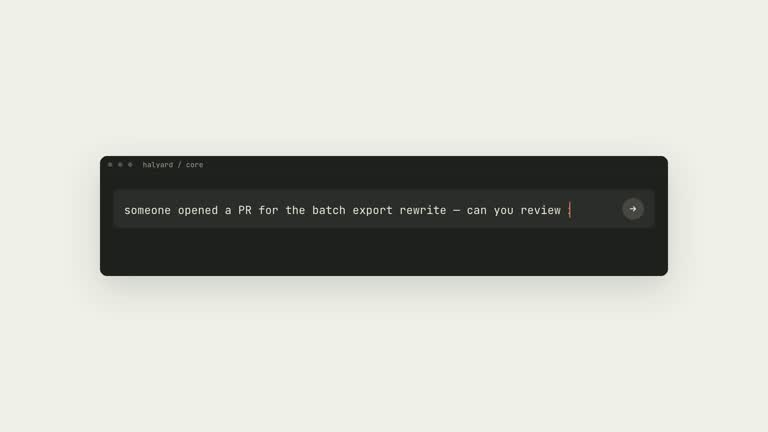
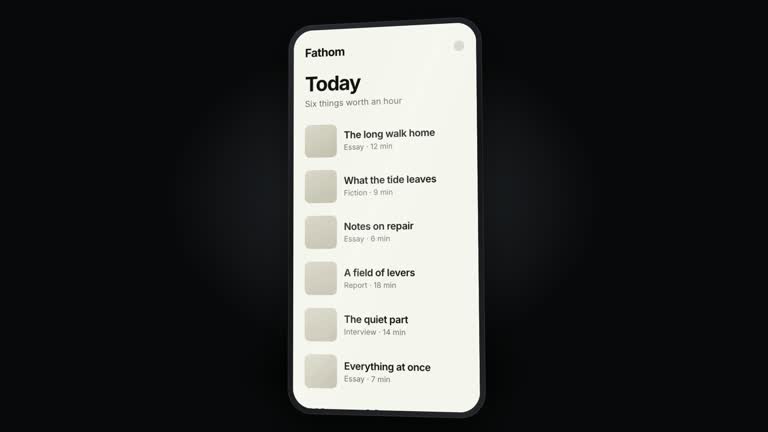
Show the request, follow-up and finished output that make an integration useful. Chat-to-Result builds a narrated launch film inside a dark interface: the connector is enabled, an answer streams in and a second request triggers the result. Voice timing organizes the cut, while a defensible headline number can give the final output a clear scale.
What you get
A guide for producing a thirty-to-forty-five-second, 1920×1080, 60 fps H.264/AAC launch MP4 with narration, a music bed and timed click/typing effects.
A seven-scene plan covering connector setup, question, streamed answer, follow-up, a brief thinking pause, result and outro. The result develops from a completing checklist into an output card with an optional real count-up statistic.
An interface system for near-black canvas, three panel elevations, composer, menus, toggle, tool chip and result card, with restrained product accent colors. The authored UI should use the product’s approved surfaces or a declared neutral original.
Instructions for an editable project with script, word-level transcript, per-scene compositions, cut ledger and shared stylesheet. The package supplies these authoring references rather than a ready-rendered video or complete executable project.
Before you choose
Choose this when an integration’s usefulness becomes apparent after a follow-up request. Establish that hinge first: the second prompt should make it obvious why your product is needed. Then fit the visuals to a clear voice read instead of rushing narration to fill an existing animation slot.
Good fit
A connector, plugin, integration or agent skill whose value is clearest through a specific invocation and output.
A product where a complete request-to-result story explains more than a disconnected feature tour.
A team with a meaningful result and a measured number it can defend publicly, or willing to show the output without a count-up.
Not for
A product without an interface or a capability that cannot be shown through one coherent interaction.
A silent launch film. This structure derives scene timing from narration and its actual word timestamps.
Recreating an unapproved third-party host app. The documented alternative is a neutral original interface identified as representative.
How to use
You say/hyperframes-chat-to-result-launch Make a launch film for Relay, our new connector — someone asks a question and it builds the report.
Provide the product, invocation, actual first question and follow-up, supported task steps and output. Supply a real headline number with its unit and basis, or omit the count-up. Choose an owned/permitted host surface or approve a neutral original.
Prepare HyperFrames CLI, Node.js 22 or newer and FFmpeg and the audio/motion workflows referenced by the guide. Supply a recorded voiceover or a script for the CLI voice route described in the package, confirming the installed toolchain’s availability.
Lock and transcribe the voice before timing scenes. Use the real word timestamps for the seven-scene storyboard and cut ledger; rerecording a line reopens the timing of every scene it touches.
Build the monochrome interface and result sequence from real labels and output material. Keep the composer aligned across its opening cut, make checklist steps truthful and drive the count-up from the animation timeline rather than a wall-clock interval.
Check scene snapshots and replay with narration. Verify result readability, focus and message order, test the same sought frames for count-up consistency and keep click cues on their press frames. Render and probe the final video for dimensions, frame rate, duration and an audio stream before delivery.
Requirements and costs
You bring
The product and the exact action a user takes to invoke it · An interface you own, or approval to build a neutral original one · The question a user asks and the follow-up that triggers the product · One real headline number the result can count up to · A voiceover script, or a recorded voiceover file
v1.0.0 — Claude Code / Claude Desktop / Cowork / Codex / ChatGPT
FAQ
The package expects explicit permission to recreate a third-party app. Otherwise author neutral original chrome and icons without its mark or signature layout and identify the surrounding surface as representative. The film should not imply that an invented shell is a specific live product.
You can supply a recording, or the guide describes synthesis through the HyperFrames CLI’s local voice route. Confirm that route in the installed toolchain. Either way, transcribe the final audio to word-level timestamps before timing the film; the voice is the clock.
The prescribed implementation uses a timeline-driven value and updates the displayed number from that tween, rather than a timer. That makes a chosen frame reproducible when implemented correctly. The typing likewise uses a width reveal; verify both on the authored project before claiming the render matches the preview.
Remove the count-up and end the result scene on the actual output. A dramatic number should measure something real, not be invented to occupy the headline slot.
No. It provides a production method for an authored interface film. Base the depicted invocation, task order and output on verified product behavior; a code-drawn scene by itself is not evidence of a successful live run.
User reviews
—0 reviews
Select a star to share your experience.
No reviews yet. Ratings appear once readers share real experiences.