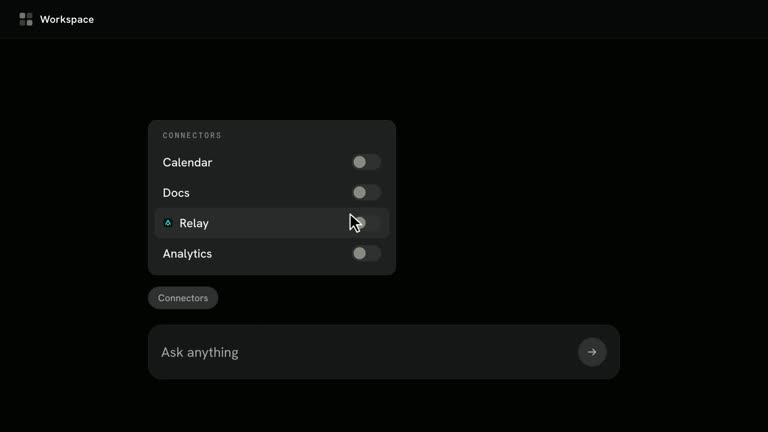
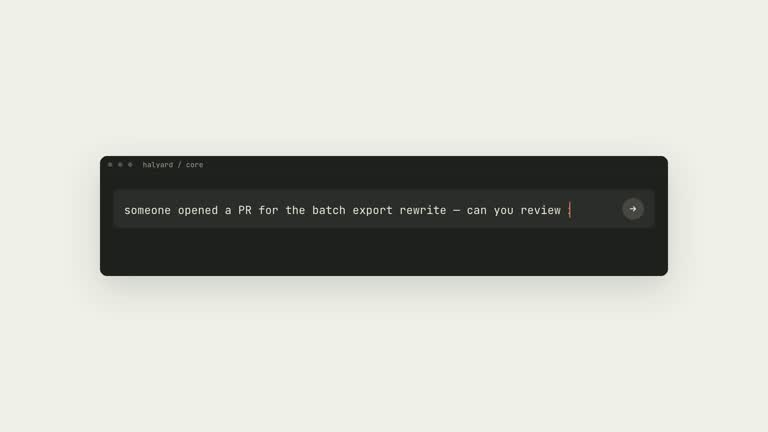
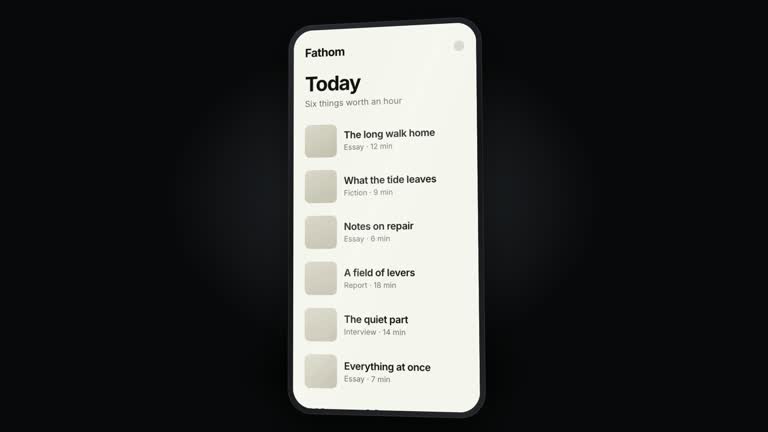
Show one capability across several supported ways of working, then let the actual outputs carry the launch. Agent-Chorus repeats an identical prompt on four differently shaped surfaces before a musical drop opens a fast result reel. The closing command gives viewers one next step; the four demonstrations support a specific compatibility story rather than a claim that the product works everywhere.
What you get
A blueprint for a twenty-four-to-forty-five-second, 1920×1080, 30 fps H.264/AAC launch MP4: prompt and four-surface chorus, beat-cut output reel and a closing install or invocation command.
A method for declaring the prompt once and reusing it character-for-character across the surfaces. The chorus accelerates from a full typed demonstration into faster recognizable repetitions.
A reel specification using real product outputs, the track’s measured tempo/drop and frame-snapped cut timecodes. The reference shape establishes the reel slowly, moves onto each beat and uses a brief faster burst before a held final output.
Instructions for creating an editable HyperFrames project, storyboard cut grid, beat data and cut ledger. The archive contains production, reel and retarget references; the branded project and rendered MP4 are results to create, not files already supplied.
Before you choose
Choose this after confirming the same short action works in four meaningful contexts. Start with that verification and the strongest eight outputs, then choose the track. Musical precision can make the evidence memorable, but it cannot supply compatibility or output quality that the product has not demonstrated.
Good fit
A CLI, package, plugin, server or agent skill that genuinely performs the same capability through several surfaces.
A product with at least eight strong real outputs, ideally around twelve, available for the result reel.
A launch with a suitable supplied music track whose clear drop can carry the change from repeated prompts to output range.
Not for
A product that runs only in one environment. Inventing extra surfaces would undermine the central claim.
A launch without real outputs yet. A fast montage of fabricated mockups is not product evidence.
A soundtrack without a useful drop, where the two movements would need a different structural transition.
How to use
You say/hyperframes-agent-chorus-reel Our package works in any coding agent. Make the film where four of them type the same line.
Lock one short prompt or command and verify the four contexts in which the product actually supports it. Gather eight to twelve genuine outputs and the closing command, recording what each output came from.
Choose owned or explicitly permitted surfaces, or neutral originals clearly identified as representative. Distinguish the surfaces by shape—terminal, docked panel, inline field or floating composer—without implying an unverified specific integration.
Prepare HyperFrames CLI, Node.js 22 or newer and FFmpeg and the referenced motion/audio guidance. Select the track before building, find the beat grid and exact drop, and write frame-snapped reel cut times into the storyboard.
Build the chorus from one shared prompt string and the reel from the actual outputs. Use hard cuts and only one visible output at a time, with a controlled acceleration that echoes the chorus rather than a single mechanical rate throughout.
Inspect frames around representative reel cuts to check the grid alignment, then replay with sound. Check prompt identity, supported surface claims, output provenance and the working closing command. Run documented project/output checks and verify final canvas, frame rate, duration and audio, retaining the beat plan and editable project.
Requirements and costs
You bring
The product and the one prompt or command that invokes it · Four surfaces it genuinely works in, with a rights position on each · Eight to twelve real outputs the product has actually produced · A licensed music track with a real drop · The install command the film closes on
v1.0.0 — Claude Code / Claude Desktop / Cowork / Codex / ChatGPT
FAQ
Recognition is the device: after the first instance, viewers recognize the action across other surfaces rather than read a different request each time. Declare one string and let all four views consume it so wording cannot drift while editing.
The package expects an owned or explicitly permitted representation for each surface. Otherwise it uses neutral original interfaces with different shapes and identifies them as representative. A neutral visual does not itself establish support for a named tool; verify compatibility separately.
The guide derives the cut grid from detected beats and the exact drop, then snaps times to frames. Check frames around several cuts and listen at normal speed. A nominal tempo alone does not guarantee that a particular track’s transients and rendered cuts align.
Eight strong examples are preferable to twelve uneven ones. They should be actual product results, not scenes fabricated merely to fill the reel. Adjust the cut plan to the usable material rather than lower the standard.
No. The download contains the production and reel references. An agent still authors the surfaces, timeline, storyboard and branded MP4 with the HyperFrames toolchain.
User reviews
—0 reviews
Select a star to share your experience.
No reviews yet. Ratings appear once readers share real experiences.