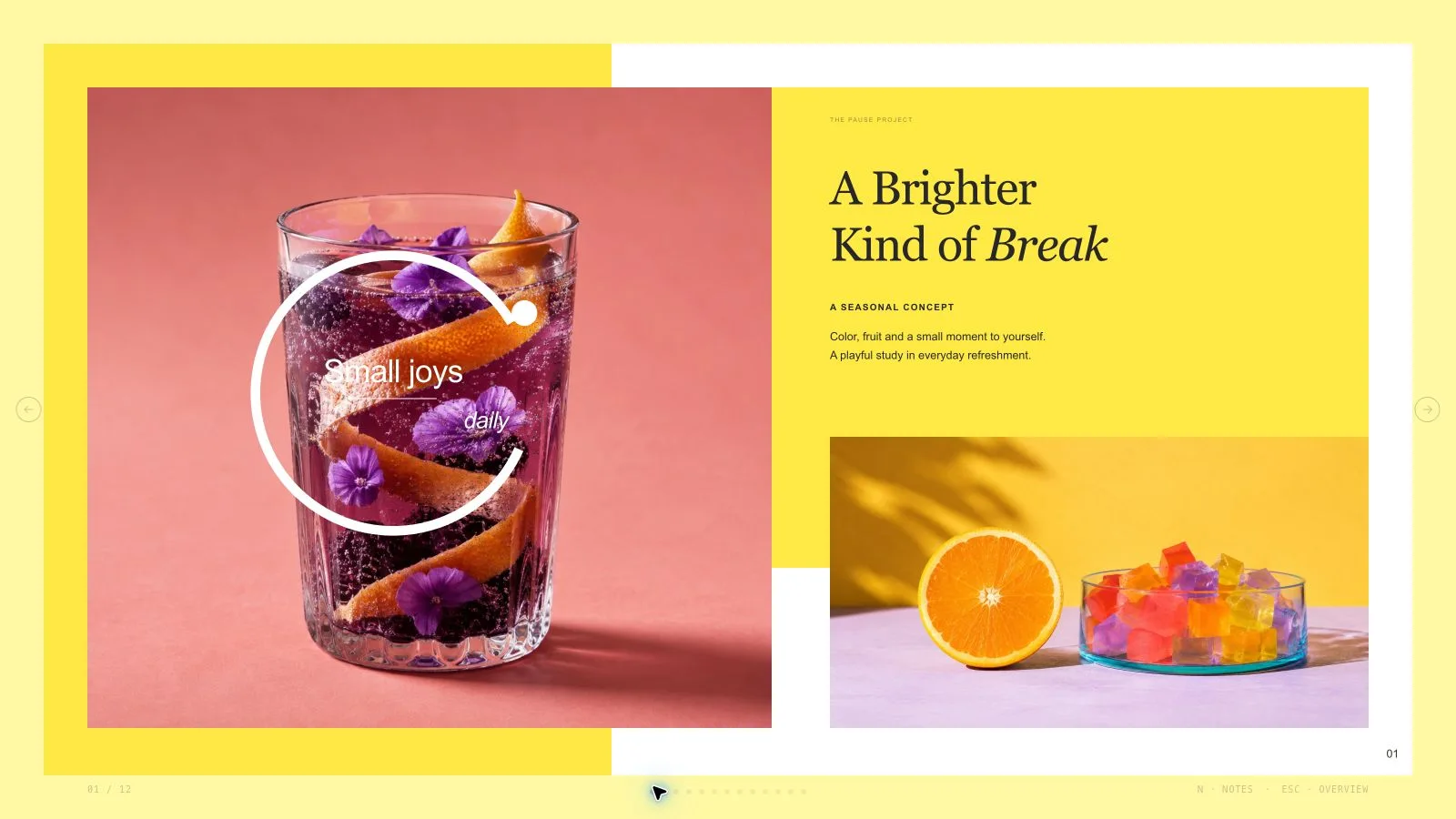
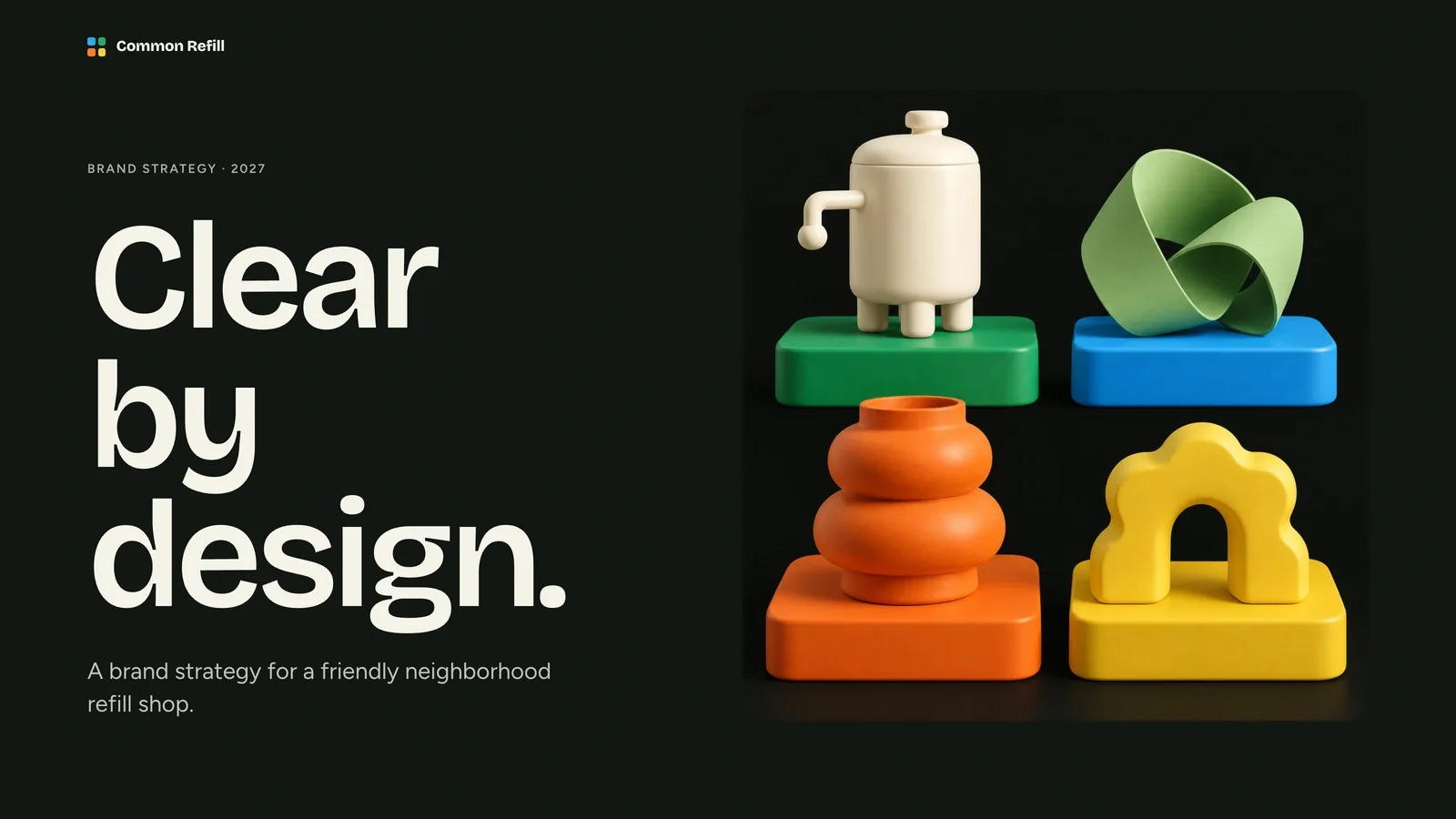
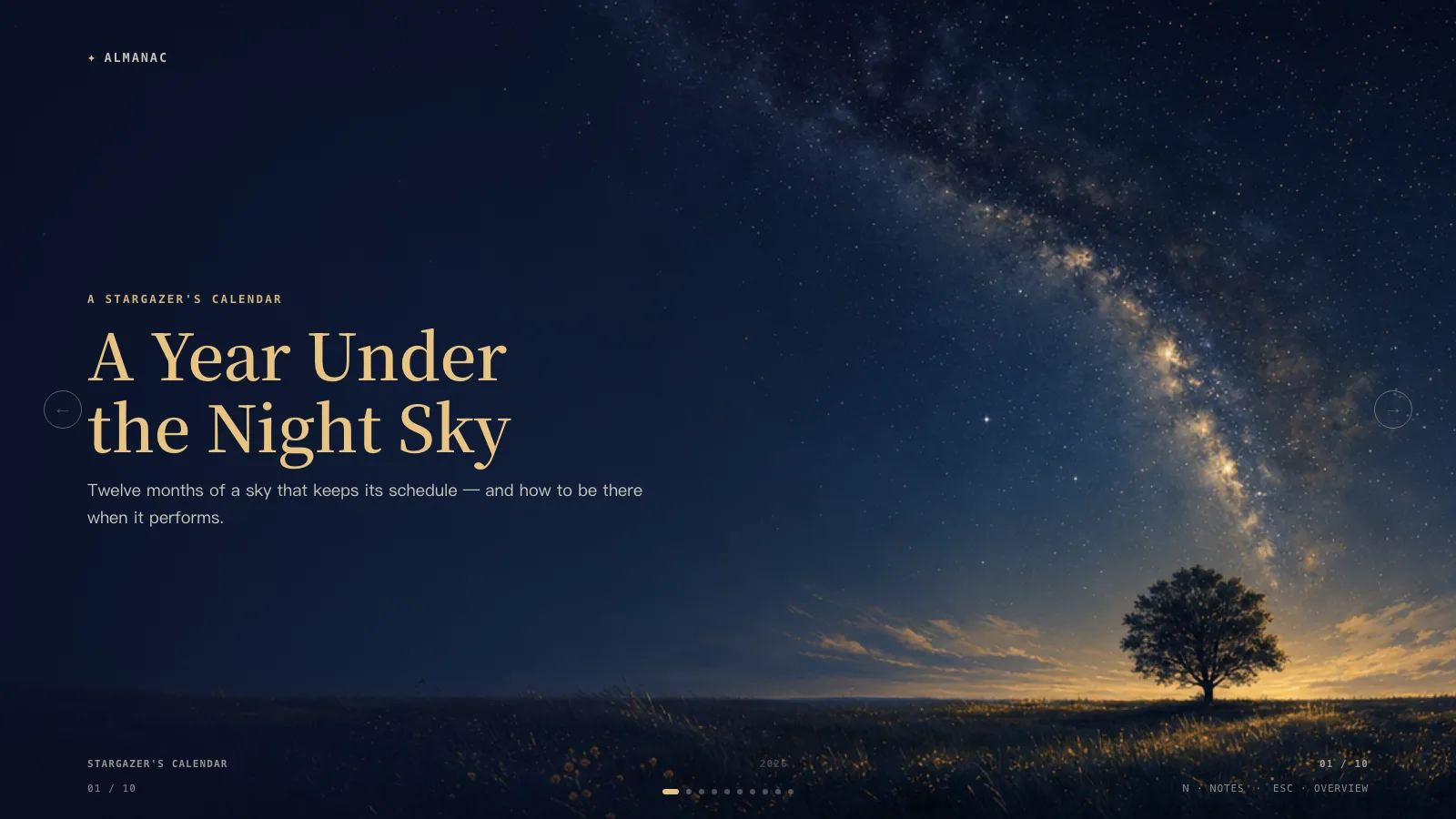
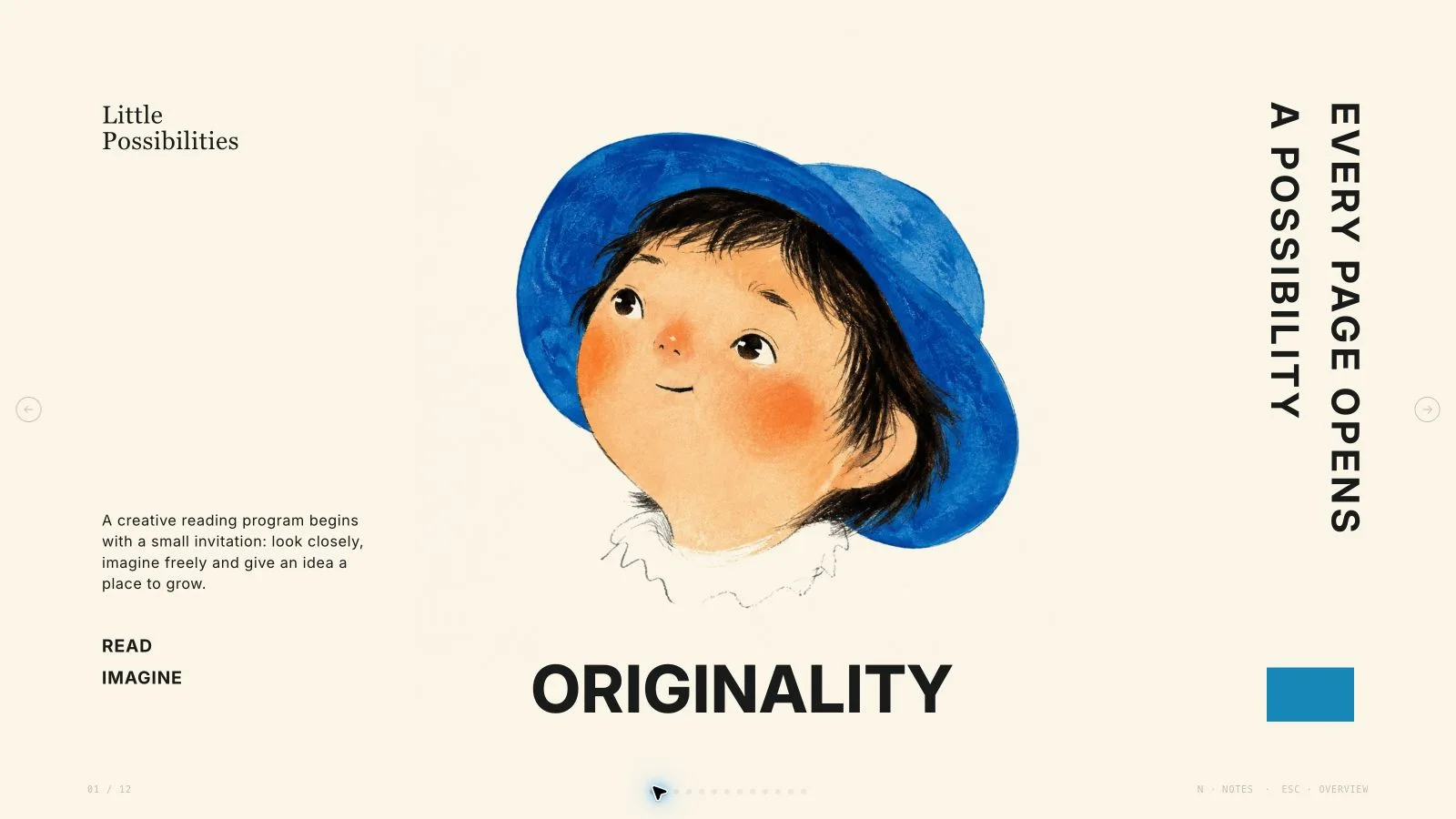
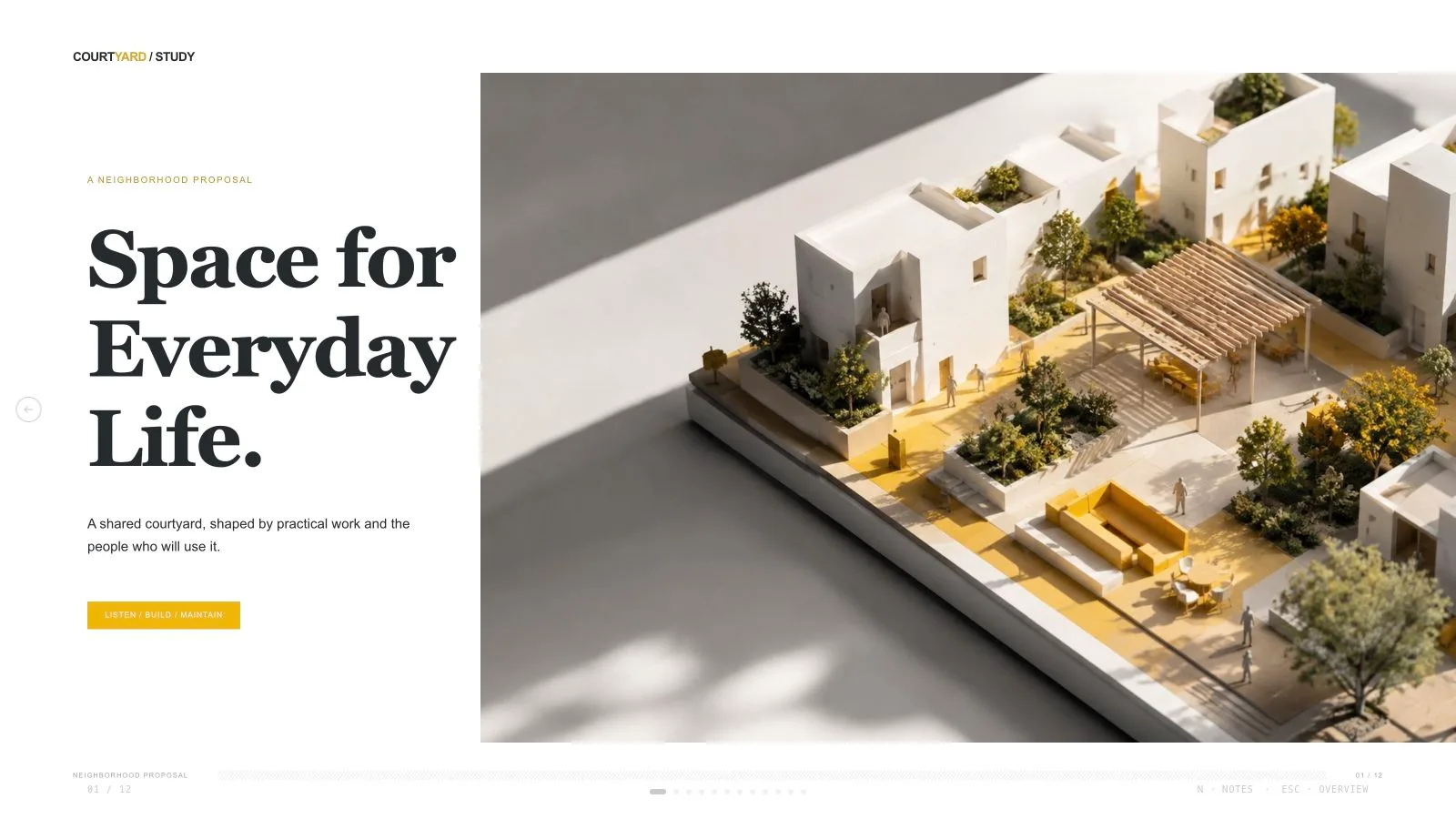
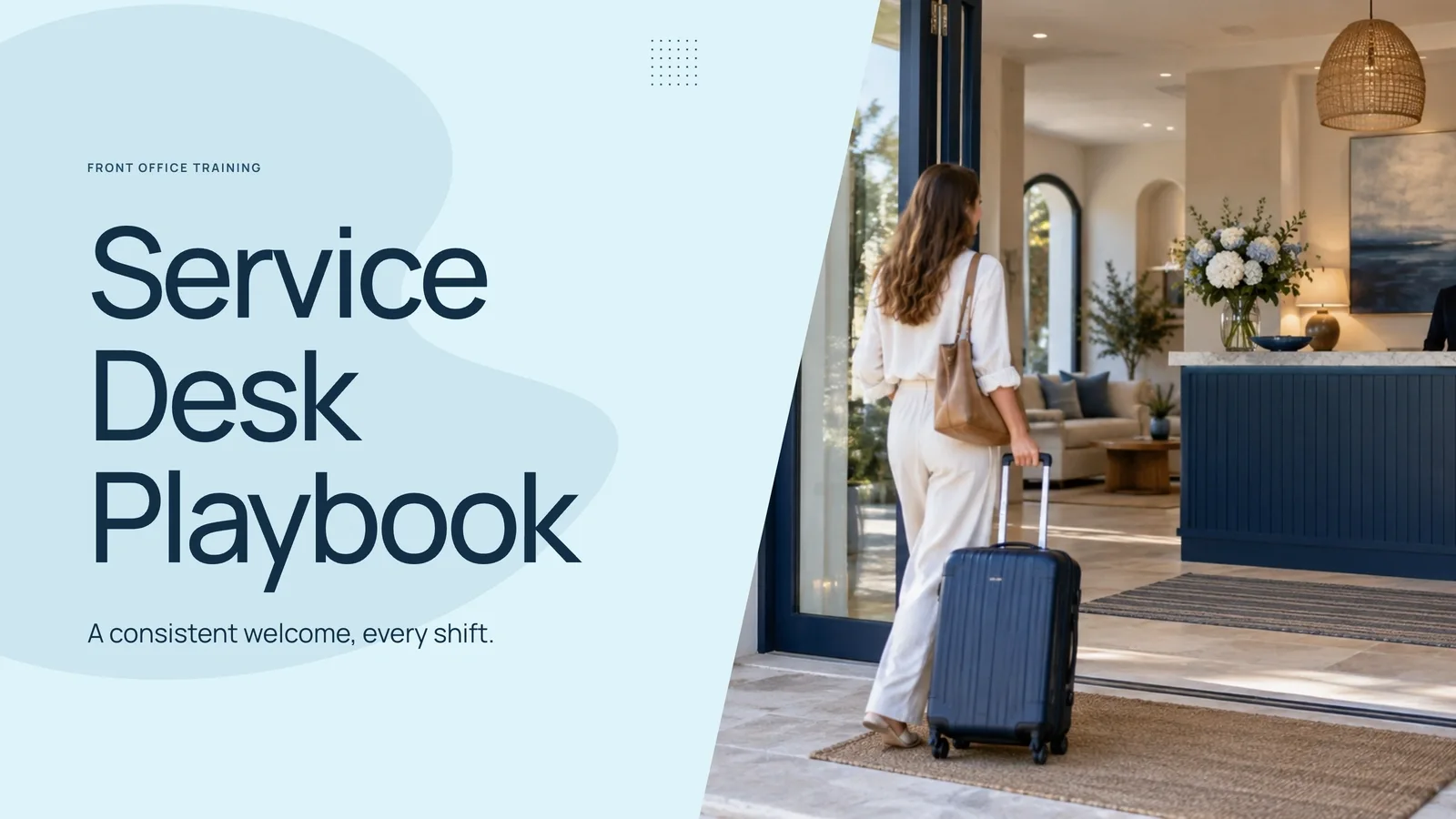
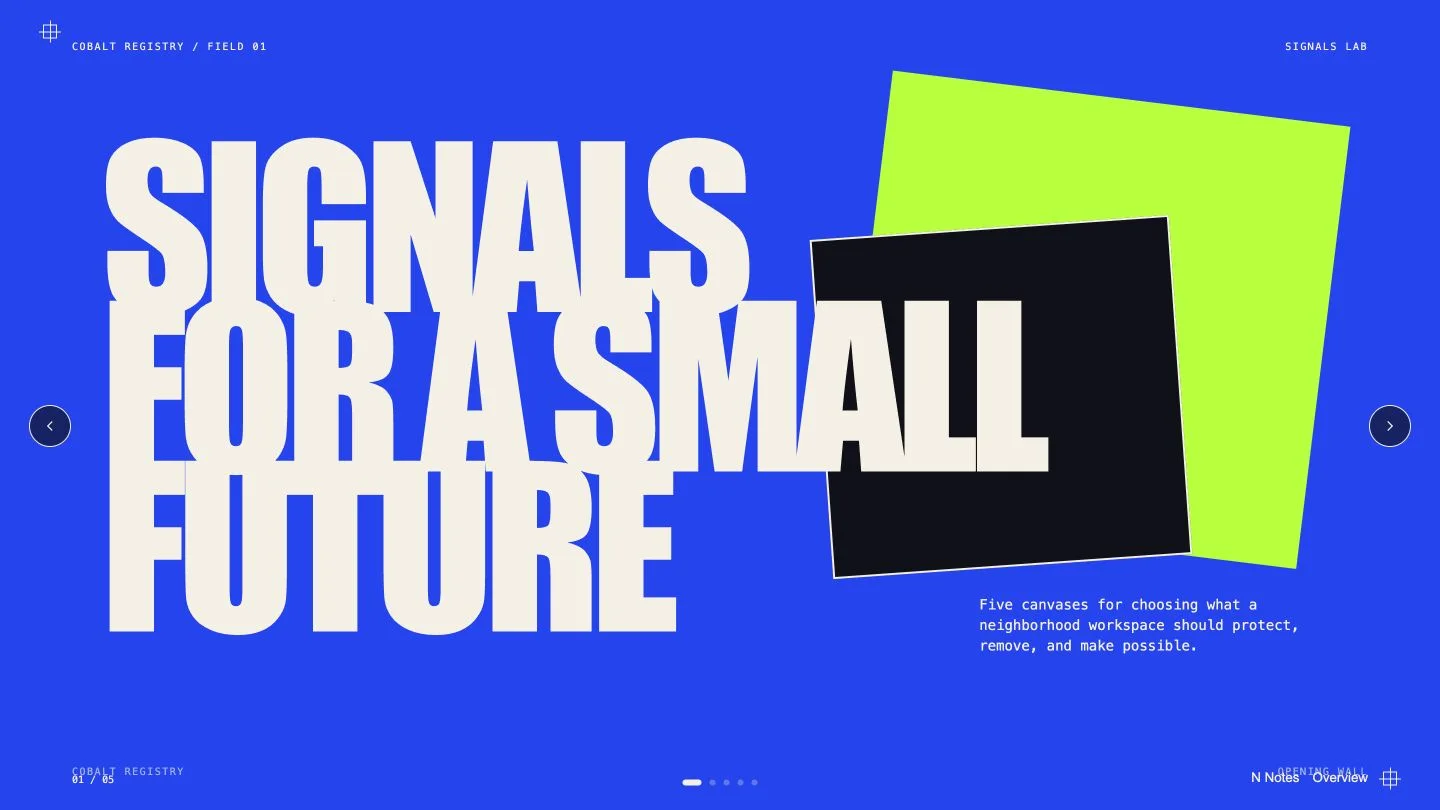
Shape a product, company or idea brief into a spoken narrative with clear sections, evidence and next steps. Soft Gradient Deck uses grainy low-saturation washes, very heavy black headings and generous empty space. It builds discrete editable slides rather than a scrolling page; facts, metrics and quotes still come from your approved material.
What you get
Eight composition types—cover, text/media split, numbered section, process/steps, content grid, stat row, quote and closing—represented by nine starting kit recipes because the split has more than one example. Select, repeat or extend recipes to match the agreed story; eight to twelve pages is only starting guidance when no count is specified.
Three light-only background treatments: warm Sunrise pink/cream/mint/yellow washes, cool Dusk blue/lilac/mint washes and flat Paper. Grain belongs on warm/cool gradients, never the flat field; do not add dark/black pages. Rotate treatments so three identical backgrounds do not occur consecutively, keeping at least roughly thirty percent empty space.
Oversized 800–900-weight system grotesk headings with compact supporting copy, consistent brand/footer details and no decorative header arrow. Parallel step/card text keeps comparable length; aim for three to six steps, two to three grid cards and up to four verified statistics where those layouts fit. Two to three short sentences are enough for a body paragraph; longer explanation needs notes or another slide.
Two local catalog illustrations show pastel paper cards and document-to-slide flow; the latter is subject-specific. CSS-only pages can stand without new imagery. Optional media frames must be filled with suitable assets or explicitly disclosed; a finished story does not require invented screenshots, product photos, metrics or testimonials.
A generated self-contained 1280×720 HTML deck with embedded assets, navigation, overview/thumbnails, speaker notes, editing, presentation mode and print styling. Current delivery uses the shared editor rather than the old bespoke paging engine or companion images folder. The installed generic schema fixture is not a finished custom deck.
Shared Python structure/offline-shell checks and composition reports cover count/schema/runtime issues, unfilled images and leftover example strings; background rhythm and visual page labels still require review. Optional PPTX keeps native text/notes and separate pictures with rendered decorative layers; PDF printing gives one 16:9 slide per page. Inspect actual exports/fonts before claiming them complete.
Before you choose
Make the proof legible before styling the story. A short launch or update needs a clear claim, supporting material and next action—not a metric invented to fill a stat row. Preserve context in notes and use the warm/cool/flat rhythm to pace the argument rather than manufacture variety through extra content.
Good fit
A founder or marketer has a product-launch, company update or idea outline and wants a clear problem/solution/proof/next-step narrative.
A presenter intends to talk through the deck live using notes and an overview rather than hand over a dense report.
A team can supply trustworthy facts, metrics and quotes and review the generated story; the design framework does not verify business claims.
Not for
Dense data-heavy reports that require small text, long tables and little empty space.
An all-native-object PowerPoint or Google Slides deliverable. Current PPTX export exists, but complex backgrounds/effects are rendered and Google Slides is not a direct native output.
A guarantee of free new AI artwork or fabricated screenshots, photography, metrics and customer attributions.
How to use
You say/soft-gradient-deck Create a soft-gradient presentation from my topic and outline as one self-contained HTML file, with full 16:9 slides, grainy pastel gradients and heavy black headlines. Include page navigation, a thumbnail overview, speaker notes and print-to-PDF export.
Provide an outline/content brief, audience, purpose, accurate source material and intended next action. Agree the slide count from content and duration; eight to twelve is only a starting proposal when unspecified. Copy defaults to English unless another language is requested. Identify supported facts and omit a stat/quote page if the required evidence is absent.
Plan the narrative and choose one recipe and warm/cool/flat treatment per page. Do not force all eight archetypes into a narrow story. Keep three consecutive backgrounds from matching, flat pages free of grain and all pages light. Use large heavy type and open space instead of a dark inversion to emphasize a quote or closing.
Keep step/card descriptions parallel and paragraphs to two or three short sentences. Split crowded grids rather than adding a fourth card. Use verified statistics or truthful qualitative values, and attribute a quote only to its actual source; an original brand position can stand without a fabricated speaker. Write notes as supporting talking points rather than duplicate page copy.
Replace generic brand/domain/date labels and update visible page labels when ordering changes. Retint the base ink/paper/accent and six pastel blob tokens only when needed, retaining low saturation and strong text contrast. System fonts avoid network requests; embed a licensed supplied custom font only when required, never a webfont-service link.
Prioritize supplied images, then suitable library reuse, generation for gaps or all-new art; reuse is the fallback without a choice/tool. The two local illustrations are optional and the document-flow scene needs a matching subject. Keep each pictorial source on one page, use kit slot ratios and record prompts/results. New art should be flat, minimal, pastel editorial illustration with no baked-in words or fake identifiable product/people assets.
Generate optional art through built-in tools or the FAL helper/FAL_KEY, subject to host limits or separate provider charges. Submit paid tasks once then poll/fetch, without automatic paid replacement. Keep credentials out of deliverables and list unfilled frames; remove optional media groups where appropriate instead of implying a placeholder is a supplied image.
Compose approved text, alt descriptions, images, labels and data from recipes and remove unused nodes. Python 3 handles compose/build/static checks; optional media tools use Node. Resolve unfilled-image and leftover-example reports, verify the count and inline fonts/resources below 20 MB. Shared structural checks do not establish background rhythm, correct claims or visual fit.
Inspect all pages over local HTTP for treatment rhythm, grain placement, heavy-title fit, parallel card density, image crops/uniqueness, bounds, contrast, note usefulness and visible page labels. Test navigation/overview, notes, editing, block/layout/color changes, undo/redo, Save/reopen and presentation mode. Deliver page-view HTML with Edit/E and Save instructions: recovery is browser-local, Save (Cmd/Ctrl+S) writes portable edits.
Set interface/content locales independently with framework CJK/RTL support. Use current controls rather than assuming retired wheel/ESC/N shortcuts. Create/check/inspect requested PPTX/PDF and recipient fonts separately. The shared editor has no per-style theme picker and its embedded PPTX menu replaces the retired mandatory Node/Chromium export chain; photos do not require an old companion folder.
Requirements and costs
You bring
Deck outline or content brief
Dependencies
FAL API key — optional (AI-generated gradient visuals) · Chrome, Chromium or Edge plus Node.js 20 or newer — required only for PowerPoint export
Outside costs
FAL GPT-Image usage charges apply when generating AI visuals.
Publisher testing
v1.0.5 — Claude Code / Claude Desktop / Cowork / Codex / ChatGPT
FAQ
Not for CSS-only pages, suitable supplied pictures or relevant bundled assets. Optional new illustrations can use available built-in generation or FAL/FAL_KEY with separate provider charges. Paid tasks are submitted once then polled/fetched. Flag unresolved media frames instead of presenting them as completed imagery; optional image groups can be removed when the story still works.
An outline or content brief, audience, intended action and accurate facts, figures and quotations. Agree length from material and duration; eight to twelve slides is starting guidance, not a required output count. The Skill organizes a narrative but does not research or validate business evidence automatically.
Open the self-contained HTML and use the shared editor’s page-view, navigation, overview, notes and presentation controls. Save writes portable changes; current output embeds images. Check requested PPTX or print/PDF separately. Old wheel/touch/ESC/N claims described a retired bespoke engine and are not guarantees for current controls.
Mix warm Sunrise, cool Dusk and flat Paper across selected layouts, avoiding three identical treatments in a row. Keep grain off flat pages, preserve open space and vary composition rather than filling every gap. This is a visual acceptance task; the shared structural checker does not prove the background rhythm is good.
Yes. Enter Edit to change words, pictures, order, colors, layouts and notes, then Save. Named background treatments guide generation; there is no style-theme switcher. Current embedded PPTX export replaces the old no-PPTX restriction and mandatory Node/Chromium chain. Python builds/checks the source and optional media tools use Node. Text/notes and pictures remain separate, decoration/effects are rendered and recipient fonts/wrapping need inspection.
User reviews
—0 reviews
Select a star to share your experience.
No reviews yet. Ratings appear once readers share real experiences.