Provide the product name/promise/audience, account and payment features, supported currencies/rails, approval rules, FX pricing, forecast/reporting needs, tiers/prices, offices and primary CTA. Gather approved customer proof and security/custody/partner facts. List ordinary missing content as placeholders; omit unsupported institutional claims rather than inventing them. Adapt disclosure wording to the confirmed company status and leave explicit gaps for missing partner details.
With no project, adapt the self-contained template and embed local images/fonts. For deployed static hosting, keep adjacent local files if desired. Inspect an existing/requested framework’s conventions and split sections, routes, data and charts into actual components/modules; preserve unrelated files and do not paste the entire original page into a wrapper. Restyle any requested React component primitives to the template tokens rather than shipping library defaults.
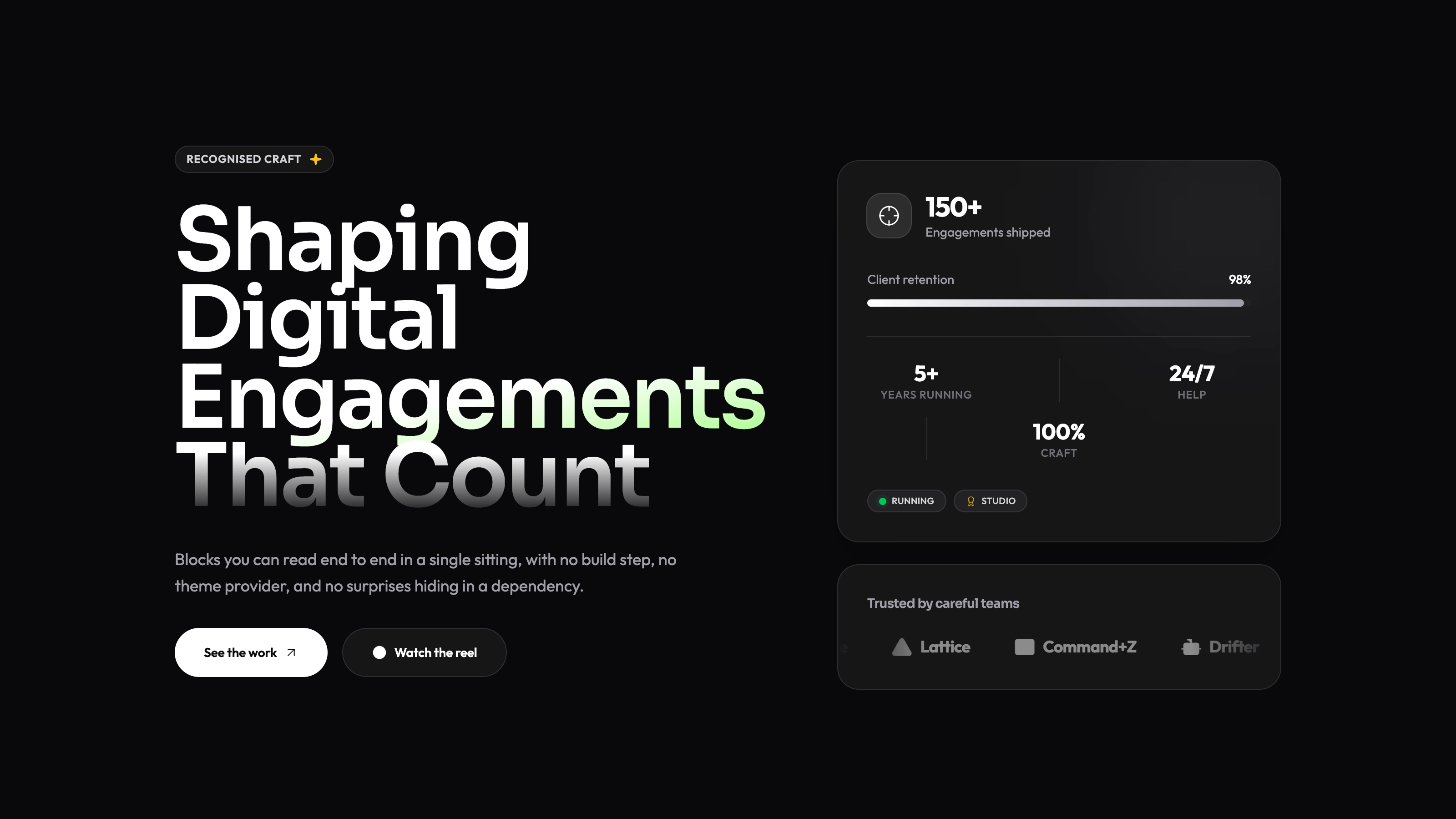
Keep the hero’s restrained composition: medium-weight 58px maximum claim, short lead, two buttons and one balance panel, without announcement pills, extra stat strips or floating cards. Maintain Hanken Grotesk and Geist Mono/tabular figures, a 1248px rail container, aligned full-width hairlines and varied section compositions. Large surfaces remain neutral near-black; use silver emphasis and keep green/red/amber semantic. A requested light mode requires a complete second system, not a single inverted section.
Map the four product views to real differentiators. Cards/payments can use spend controls, payouts and reconciliation; payroll/expense can use departments, payroll runs, reimbursements and headcount costs; accounting can use receivables/payables and invoice runs. Keep a coherent object vocabulary across panel, code snippets, map, story and releases. Three tabs require updating grid, panel and footer references together; do not merely hide the fourth trigger.
Align every financial example: entity balances and rates determine hero/dashboard total and donut shares; account/bank/entity counts must agree with captions and story facts. Synchronize supplier-batch count/amount/release time across approval, audit and upcoming items, and fee claims across converter, plans, comparison, FAQ and terms. Update static hero legend/fallbacks as well as arrays. Real numbers require permission or explicit demonstration labeling.
Qualify approval and FX behavior. The supplied approval handler marks the sample run approved after a delay and claims future release without submitting payments. FX charges a hardcoded 0.25% sample fee, accepts a sample amount range and computes output locally; the quote moves randomly within bounds, then freezes for the lock UI. Convert ends in a timed success/arrival claim, not a trade confirmation. Replace limits/fee/rate/arrival assumptions and test expiry, repeat, route-change, offscreen and hidden-tab behavior before connecting services.
Keep the thirteen-week forecast understandable: base/up/down scenarios use predefined net-flow arrays accumulated from the example total cash; the minimum-cash line and low/end/buffer figures must agree. The sample chart has a fixed dollar-million scale and threshold, so different business magnitudes need revised axes/labels as well as data. Dashboard display conversion uses local rates, not live FX quotes or a statement import.
Adapt the global map’s pins, account metadata, arcs, rail names and stats together. Preserve pointer/touch tooltips and ensure they do not create hidden overflow on phones. Geography and glowing pins demonstrate locations/corridors, not licensed coverage, banking partners or live operational health. Review roles/policy switches and code-copy actions as interface examples unless an actual system is connected.
Set two to four pricing plans and matching grid/comparison values in the same order, with annual-rate labels and yearly totals matching approved prices. The sample annual-discount language must not survive unsupported pricing. Keep entity count within the donut’s four tones, quote grid to two or four entries and logo symbols/marquee sets aligned. Other stat/rail/capability grids need column changes when their content count changes.
Plan five photography roles rather than dashboard screenshots: customer environmental portrait and workplace matching the industry, a coherent four-face avatar grid, demo host at work and one security detail. The vault image is neutral; avatars/host are generated stand-ins and need disclosure or replacement with approved real photos. Regenerate the logistics CFO/port pair for another industry. An agent image tool may charge; supplied photographs are an alternative, and no Skill-specific API key is needed for the local interface.
Replace brand/metadata/logo/footer, accessible panel names, API/package/key examples, customer-story slug/facts/quote/timeline, demo host name, partner references across all disclosure locations and legal/contact addresses. Update the fixed example date and dependent dates. New names do not make the depicted balances, quotes, security reports or partner relationships true. List remaining placeholder facts and stand-in photos for review.
Walk the two-step application and sign-in as local UX. Company-email checks reject listed free domains; password/code fields and terms errors need keyboard testing. The code handler accepts any complete six-character entry rather than verifying a server-issued secret. Timed sent-link, application and signed-in states do not create an account or authenticate. Keep SSO/password-recovery feedback explicitly demonstrative until services are implemented.
Treat demo scheduling as a selection UI: five business days are generated from a fixed October 2026 example date and five fixed time labels, with confirmation expressed in ET. It does not check a host calendar, reserve availability or email an invite. Replace fixed-date/time-zone assumptions and success wording for actual use; test missing day/time, validation, confirmation and route-return states.
Build offline output with Node.js 18+ and initial internet access to download/embed the two fonts and local photos. Stop on missing/download errors instead of silently accepting system fonts. Target under 5 MB and remain under the 8 MB validator cap. Validate final HTML or local-files output with referenced files present; directory mode scans selected source patterns and cannot replace a framework’s own build/type/lint/route checks.
Review every route at 390, 768, 1024, 1440 and 1920px, including 360px overflow and full visibility of amounts/tooltips. Test tab keyboard behavior, approval/FX/forecast actions, dashboard currency, map pins, policy/code copy, billing/comparison/FAQ, changelog empty state and all form transitions. Check menu focus/Escape and scripts-only iframe paths for standalone output. Reduced motion should stop decorative ticking/countups; verify visibility/fallback and console errors, fix/recheck and report actual checks separately from source review.